
If you’re looking for a compact mirrorless camera that delivers better image quality than a smartphone without becoming too complicated, the Sony Alpha ILCE-6100K/ILCE-6100L remains an interesting option.
The Sony A6100 combines a 24.2MP APS-C CMOS sensor, fast autofocus, Real-time Eye AF, 4K video recording, a tilting touchscreen, and Sony’s E-mount lens system in a relatively lightweight body.
The camera is often sold in different kit configurations, including the SELP1650 Power Zoom lens, commonly known as Sony’s 16-50mm power zoom kit lens. This compact lens helps keep the camera portable while providing a useful focal range for everyday photography, travel and casual video.
For beginners, students, travelers, family photographers and aspiring content creators, the A6100 can be an appealing entry into interchangeable-lens photography.
But with newer mirrorless cameras now available, is the Sony A6100 still worth considering?
Let’s take a closer look.
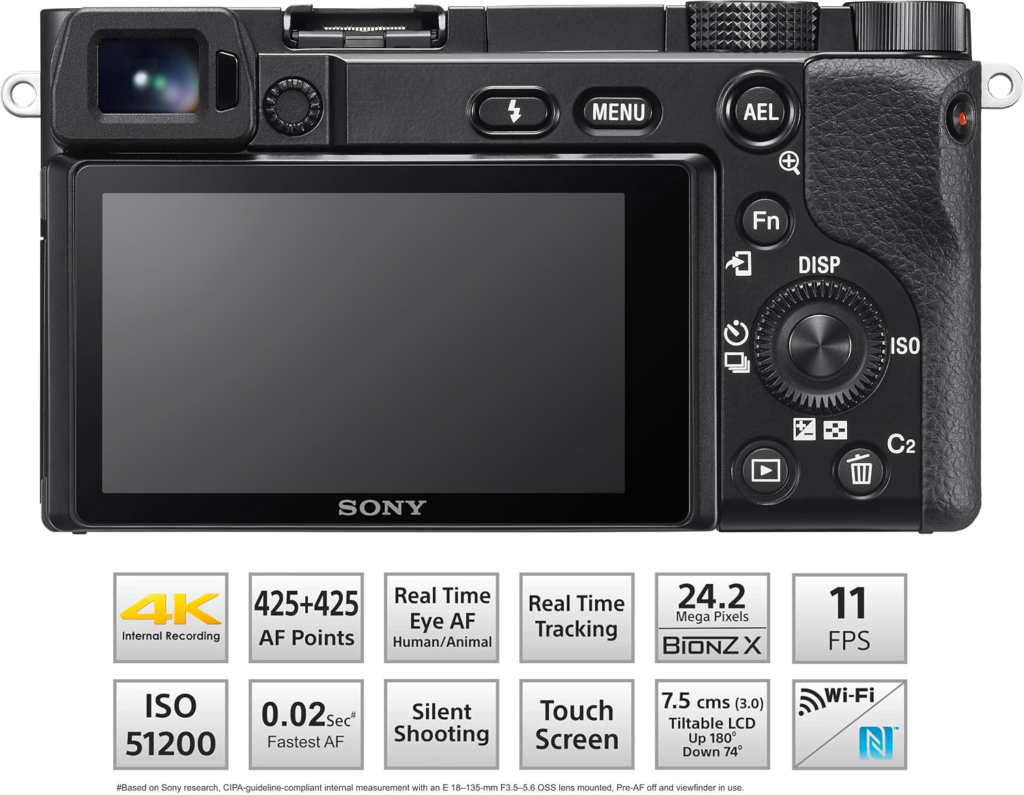
Sony Alpha ILCE-6100: Quick Overview
| Feature | Sony Alpha A6100 |
|---|---|
| Model | ILCE-6100 |
| Camera Type | APS-C Mirrorless |
| Sensor | 24.2MP APS-C CMOS |
| Processor | BIONZ X |
| Lens Mount | Sony E-mount |
| Kit Lens | SELP1650 16-50mm Power Zoom |
| Equivalent Focal Length | Approx. 24-75mm |
| Autofocus | 425-point phase/contrast detection |
| Eye AF | Real-time Eye AF |
| Video | 4K |
| Slow Motion | Full HD high-frame-rate recording |
| Display | 3-inch tilting LCD |
| Viewfinder | Electronic |
| Stabilization | Lens-based / electronic movie stabilization |
| Connectivity | Wi-Fi, Bluetooth, NFC |
| Weight | Approx. 396g with battery and card |
| Best For | Beginners, travel, portraits and everyday photography |
What Is the Sony Alpha ILCE-6100?
The Sony Alpha A6100, or ILCE-6100, is an APS-C mirrorless camera designed for beginners and enthusiasts.
It sits within Sony’s highly popular Alpha APS-C family.
The concept is straightforward: provide the image quality and flexibility of an interchangeable-lens camera while keeping the body compact enough for everyday use.
This makes it an appealing upgrade from a smartphone or basic compact camera.
You can use it for:
- Travel photography
- Family photos
- Portraits
- Street photography
- Food photography
- Product photography
- YouTube
- Vlogging
- Social media content
- Everyday shooting
The biggest advantage is that you’re not locked into the included kit lens.
As you become more experienced, you can add better lenses and gradually build your photography system.
24.2MP APS-C Sensor
The A6100 features a 24.2MP APS-C CMOS sensor.
This sensor size is significantly larger than the sensors found in most smartphones.
That gives the camera more flexibility when it comes to:
- Detail
- Dynamic range
- Background blur
- Low-light photography
- High-ISO performance
- Lens selection
The 24.2MP resolution is also more than enough for everyday photography.
You can print large photographs, crop images and create high-resolution images for websites and social media.
For a beginner camera, this is a very useful balance of resolution and file size.
Sony BIONZ X Image Processor
Sony’s BIONZ X processor handles image processing and helps power the camera’s autofocus and shooting performance.
It allows the A6100 to process images quickly while maintaining good image quality.
For photographers, the processor is particularly important when shooting continuously or working with high ISO settings.
For beginners, the technical details aren’t as important as the result: the camera feels responsive and is capable of producing detailed photographs.
Sony A6100 Autofocus
Autofocus is one of the A6100’s strongest features.
The camera uses a hybrid autofocus system with 425 phase-detection and 425 contrast-detection points covering a large portion of the image area.
This gives the camera excellent flexibility when tracking subjects.
It can be particularly useful for:
- Children
- Pets
- Sports
- Street photography
- Travel
- Wildlife
- Events
Instead of manually selecting focus points for every photograph, you can allow the camera to track your subject.
Real-Time Eye AF
Sony’s Real-time Eye AF is particularly useful for portrait photography.
The camera can detect a person’s eye and maintain focus as the subject moves.
This is a major advantage when photographing:
- Family members
- Children
- Portraits
- Events
- Pets
Eye autofocus is one of those features that becomes difficult to live without once you’ve become accustomed to it.
For beginners, it also reduces the number of photographs ruined by missed focus.
Sony A6100 for Portrait Photography
The A6100 is an excellent entry-level portrait camera.
The 24.2MP APS-C sensor provides attractive subject separation, especially when combined with a lens with a wide aperture.
The included 16-50mm kit lens can handle casual portraits, particularly around the longer end of the zoom range.
However, if portraits become a major priority, upgrading to a fast prime lens can make a dramatic difference.
A wider aperture can give you:
- More background blur
- Better low-light performance
- Stronger subject separation
- More creative control
The A6100’s autofocus makes it a particularly capable portrait platform.
SELP1650 Power Zoom Lens
One of the most common kits pairs the A6100 with Sony’s SELP1650 16-50mm F3.5-5.6 OSS Power Zoom lens.
The lens is designed to be compact.
Its collapsible design allows the camera to remain relatively small when carried in a bag.
The 16-50mm focal range is equivalent to approximately 24-75mm on a full-frame camera.
That is a useful everyday range.
16mm
Ideal for:
- Landscapes
- Travel
- Architecture
- Groups
- Indoor photography
- Vlogging
35mm
Useful for:
- Street photography
- Everyday scenes
- Food
- General photography
50mm
Better suited to:
- Portraits
- Details
- Product photos
- Tighter compositions
Optical SteadyShot Image Stabilization
The SELP1650 lens includes Optical SteadyShot (OSS) image stabilization.
This helps compensate for small amounts of camera shake when shooting handheld.
It can be useful when photographing static subjects in lower light.
For example, if you’re photographing a building at dusk, stabilization can allow you to use a slower shutter speed than you might otherwise manage handheld.
However, stabilization does not freeze moving subjects.
For people, pets and sports, you’ll still need an appropriate shutter speed.
Why the 16-50mm Kit Lens Is Useful
The lens isn’t the brightest or sharpest option in Sony’s lineup, but it has one major advantage: portability.
The lens is very small when collapsed.
That’s important because one of the main reasons to buy an APS-C camera is to keep the entire system manageable.
The A6100 + 16-50mm combination is easy to carry around for:
- Travel
- Family outings
- City walks
- Holidays
- Everyday photography
If you later decide that you need better optical quality, you can upgrade the lens.
Sony A6100 Image Quality
In good lighting, the A6100 produces detailed images with attractive colors.
RAW shooting gives enthusiasts plenty of flexibility during editing.
You can adjust:
- Exposure
- Highlights
- Shadows
- White balance
- Contrast
- Color
- Sharpness
JPEG files are also suitable for photographers who want images ready to share without extensive editing.
For beginners, the camera can deliver noticeably more control than a smartphone.
Low-Light Photography
The APS-C sensor provides a useful advantage when lighting becomes challenging.
You can raise the ISO to maintain faster shutter speeds, although image noise naturally increases at higher sensitivities.
The kit lens’s relatively narrow maximum aperture limits its low-light potential.
If you frequently shoot indoors or at night, consider investing in a faster lens.
A fast prime can significantly improve the camera’s low-light performance.
Sony A6100 for Travel Photography
Travel is arguably one of the best uses for the A6100.
The body is compact, and the 16-50mm power zoom lens keeps the overall kit small.
You can capture:
- Landscapes
- Architecture
- Street scenes
- Food
- Portraits
- Family photographs
- Cityscapes
- Indoor attractions
The 24-75mm-equivalent range covers many everyday situations without requiring multiple lenses.
For travelers who want better image quality than a smartphone but don’t want to carry a large camera, the A6100 remains appealing.
Sony A6100 for YouTube and Vlogging
The A6100 can also be used for video creation.
It supports 4K video recording and includes a tilting LCD screen.
The autofocus system can track faces and eyes, which is particularly useful when you’re recording yourself.
For beginner YouTubers, it can be used for:
- Talking-head videos
- Tutorials
- Product reviews
- Travel videos
- Lifestyle content
- Interviews
The 16mm end of the kit lens can also provide a useful field of view for handheld vlogging.
However, the screen does not fully articulate toward the front, which makes self-monitoring less convenient than on newer creator-focused cameras.
4K Video Recording
The A6100 can record 4K video, making it suitable for modern content creation.
You can use it for:
- YouTube
- Travel videos
- Family videos
- Tutorials
- Product demonstrations
- Social media content
The camera’s autofocus is particularly useful during video because it can maintain focus on faces and subjects.
For casual creators, the video quality remains more than adequate.
Sony A6100 for Beginners
The A6100 is a good first mirrorless camera because it offers both simplicity and room to grow.
You can begin with:
Auto Mode → Scene Modes → Aperture Priority → Shutter Priority → Manual Mode
This allows you to gradually learn photography.
Once you’re comfortable with exposure, you can start experimenting with RAW files, manual focus, different lenses and creative compositions.
The camera can therefore remain useful even after you’ve moved beyond beginner-level photography.
Electronic Viewfinder
The A6100 includes an electronic viewfinder.
This is particularly helpful when shooting outdoors.
Instead of relying entirely on the rear LCD, you can hold the camera to your eye and compose the photograph through the EVF.
An electronic viewfinder also allows you to preview exposure and other settings.
For photography, this is a significant advantage over many smartphone-style cameras.
Tilting LCD Screen
The camera features a 3-inch tilting LCD screen.
The screen can tilt upward and downward, making it easier to photograph from different angles.
It can also be positioned upward for basic self-recording.
However, it isn’t a fully articulating screen.
If you’re a dedicated vlogger, this is one area where newer creator-focused Sony cameras may be more convenient.
Sony E-Mount Lens Ecosystem
Perhaps the biggest long-term advantage of the A6100 is its Sony E-mount.
There are numerous compatible lenses from Sony and third-party manufacturers.
You can add:
- Wide-angle lenses
- Fast prime lenses
- Portrait lenses
- Macro lenses
- Telephoto zooms
- Travel zooms
- Wildlife lenses
This gives the A6100 significant upgrade potential.
Start with the 16-50mm lens and add specialized lenses only when you actually need them.
Sony A6100 for Wildlife Photography
The A6100 can be surprisingly capable for wildlife photography.
The APS-C sensor provides a crop factor that effectively gives telephoto lenses more reach compared with full-frame systems.
Its strong autofocus and subject tracking can also help when photographing moving animals.
For serious wildlife photography, however, the lens you choose will have a huge impact on performance.
A good telephoto lens can transform the A6100 into a much more capable wildlife setup.
Sony A6100 Battery Life
The camera uses a rechargeable Sony NP-FW50 battery.
Battery life depends on how you use the camera.
Heavy use of:
- 4K video
- LCD screen
- Wi-Fi
- Continuous autofocus
- Electronic viewfinder
will consume power more quickly.
If you’re traveling or recording long videos, carrying a spare battery or USB power solution is recommended.
Sony A6100 Connectivity
The A6100 provides wireless connectivity options for transferring images and controlling the camera.
You can use a smartphone as part of your workflow to:
- Transfer photos
- Share images
- Control the camera remotely
- Back up selected content
For social media creators, this can make it easier to move photographs from the camera to a phone before posting.
Sony A6100 Pros and Cons
Pros
- 24.2MP APS-C sensor
- Excellent image quality
- Very good autofocus
- Real-time Eye AF
- Fast subject tracking
- Compact body
- Lightweight design
- Built-in electronic viewfinder
- 4K video recording
- Sony E-mount lens ecosystem
- Compact 16-50mm Power Zoom lens
- Optical stabilization in kit lens
- Good travel camera
- Excellent beginner mirrorless camera
- Strong value when discounted
Cons
- No in-body image stabilization
- Kit lens has a relatively slow aperture
- Screen doesn’t fully articulate
- Uses older NP-FW50 battery
- Limited weather sealing
- Menu system can take time to learn
- 4K video features are less advanced than newer Sony models
- Kit lens isn’t ideal for serious low-light photography
Sony A6100 vs Canon EOS R50
The Canon EOS R50 is one of the A6100’s most obvious competitors.
| Feature | Sony A6100 | Canon EOS R50 |
|---|---|---|
| Sensor | 24.2MP APS-C | 24.2MP APS-C |
| Autofocus | Excellent | Excellent |
| Eye AF | Yes | Yes |
| Viewfinder | Yes | Yes |
| Screen | Tilting | Vari-angle |
| 4K Video | Yes | Yes |
| IBIS | No | No |
| Lens Mount | Sony E | Canon RF |
| Best For | Photography + travel | Photography + creators |
The Canon is newer and offers a more modern interface and vari-angle screen.
The Sony’s major advantage is its mature E-mount ecosystem.
If you already own Sony lenses, the A6100 becomes much more attractive.
Sony A6100 vs Sony ZV-E10
The Sony ZV-E10 was designed specifically with content creators in mind.
The A6100, meanwhile, is more of a traditional hybrid camera.
A6100 Advantages
- Electronic viewfinder
- Photography-oriented design
- Compact kit
- Excellent autofocus
- Strong everyday photography
ZV-E10 Advantages
- Creator-focused controls
- Fully articulating screen
- Better suited to vlogging
- Stronger emphasis on video
If photography is your priority, the A6100 makes more sense.
If video and vlogging dominate your workflow, the ZV-E10 may be more suitable.
Is Sony A6100 Still Worth Buying?
The A6100 is no longer Sony’s newest APS-C camera, but that doesn’t mean it has become irrelevant.
Its core features remain useful.
You still get:
- 24.2MP APS-C sensor
- Excellent autofocus
- Eye tracking
- 4K video
- EVF
- Interchangeable lenses
- Compact body
The main reason to consider it today is value.
If you find the A6100 and 16-50mm kit at a significantly lower price than newer models, it can be an excellent entry point into Sony’s E-mount system.
However, if the price difference is small, newer cameras may offer better video features, battery life, displays and processing.
Who Should Buy the Sony Alpha A6100?
The Sony A6100 is best suited for:
- Beginner photographers
- Students
- Travelers
- Family photographers
- Portrait enthusiasts
- Street photographers
- Hobbyists
- Beginner YouTubers
- Sony E-mount users
- People upgrading from smartphones
It may not be the best option for:
- Professional filmmakers
- Dedicated vloggers who need a fully articulating display
- Photographers requiring in-body stabilization
- Professionals working in demanding weather
- Users who need the latest video specifications
Is the Sony A6100 with 16-50mm Lens Worth Buying?
If the bundle is competitively priced, yes.
The camera offers excellent autofocus and image quality in a compact package.
The 16-50mm Power Zoom lens isn’t a premium optical performer, but it makes the overall system remarkably portable.
For a beginner, that matters.
A camera that’s small enough to carry everywhere is often more useful than a technically superior camera that stays at home.
You can also upgrade the lens later without replacing the camera body.
Conclusion
The Sony New Alpha ILCE-6100K/ILCE-6100L with the upgraded SELP1650 Power Zoom lens is a compact APS-C mirrorless camera that continues to make sense for beginners and travelers when priced appropriately.
Its 24.2MP APS-C sensor, excellent autofocus, Real-time Eye AF and interchangeable-lens design provide a strong foundation for learning photography.
The compact 16-50mm Power Zoom lens complements the camera particularly well, offering a versatile 24-75mm-equivalent range while keeping the package lightweight.
The A6100 isn’t perfect. The lack of IBIS, relatively slow kit lens and basic tilting display show its age compared with newer creator-focused cameras.
But its core photography performance remains solid.
If you’re looking for an affordable entry into Sony’s E-mount ecosystem, particularly for travel, portraits, family photography and everyday shooting, the A6100 can still be a smart choice.
Our Rating: 4.3/5
Best for: Beginners, travel photography, portraits, family photography, street photography and casual YouTube content.
Frequently Asked Questions
Is the Sony A6100 a good beginner camera?
Yes. Its compact design, automatic modes, excellent autofocus, electronic viewfinder and interchangeable lenses make it a good camera for beginners.
What is the Sony A6100 megapixel count?
The Sony A6100 has a 24.2MP APS-C CMOS sensor.
What lens comes with the Sony A6100?
The common kit configuration includes the SELP1650 16-50mm F3.5-5.6 OSS Power Zoom lens.
Is the Sony 16-50mm kit lens good?
It is a useful compact everyday lens. Its biggest advantages are its small size, versatile focal range and optical stabilization. Its relatively slow aperture means it isn’t the best choice for low-light shooting or strong background blur.
Is Sony A6100 good for travel photography?
Yes. The compact body and 16-50mm Power Zoom lens make it a convenient travel combination.
Does Sony A6100 have image stabilization?
The A6100 does not have sensor-shift in-body image stabilization. The included 16-50mm OSS lens provides optical stabilization.
Is Sony A6100 good for YouTube?
Yes. It supports 4K video and has excellent autofocus. However, dedicated creator cameras with fully articulating screens may be more convenient for serious vloggers.
Does Sony A6100 have an electronic viewfinder?
Yes. The A6100 includes an electronic viewfinder, making it useful for photography in bright outdoor conditions.
Can I change lenses on the Sony A6100?
Yes. The camera uses Sony’s E-mount and supports a large selection of Sony and third-party lenses.
Sony New Alpha ILCE-6100K -16% OFF
Sony New Alpha ILCE-6100K/6100L -16 OFF