
If you’re ready to move beyond smartphone photography but don’t want to spend a fortune on a professional camera, the Canon EOS R100 24.1MP Mirrorless Camera is one of the entry-level options worth considering.
Designed for beginners, students, travelers, families, and casual content creators, the EOS R100 combines a 24.1MP APS-C CMOS sensor with Canon’s RF lens mount in a small and lightweight body. It offers the advantages of interchangeable lenses while keeping the controls relatively straightforward for first-time camera users.
The camera is particularly interesting for buyers who want better image quality, optical zoom flexibility, and more creative control than a smartphone can provide without moving straight into a more expensive enthusiast camera.
In this Canon EOS R100 review, we’ll look at its specifications, image quality, autofocus, video performance, battery life, advantages, limitations, and whether it makes sense to buy in India.
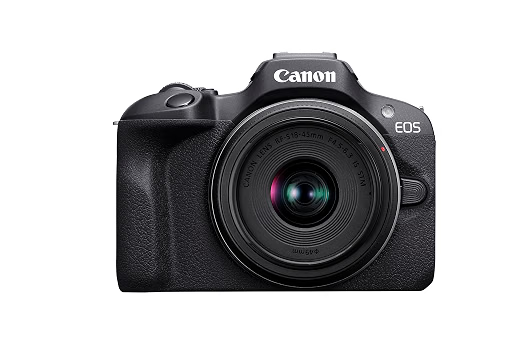
Canon EOS R100: Quick Overview
| Feature | Canon EOS R100 |
|---|---|
| Camera Type | Mirrorless |
| Sensor | APS-C CMOS |
| Resolution | 24.1MP |
| Processor | DIGIC 8 |
| Lens Mount | Canon RF |
| Autofocus | Dual Pixel CMOS AF |
| ISO Range | 100-12,800, expandable |
| Continuous Shooting | Up to 6.5 fps |
| Video | 4K UHD |
| Display | 3-inch LCD |
| Viewfinder | 2.36-million-dot OLED EVF |
| Connectivity | Wi-Fi, Bluetooth |
| Battery | LP-E17 |
| Body Weight | Approx. 356g |
| Best For | Beginners, travel, everyday photography |
What Is the Canon EOS R100?
The Canon EOS R100 is an entry-level APS-C mirrorless camera from Canon’s EOS R system.
It is aimed primarily at people who want to upgrade from a smartphone or basic point-and-shoot camera to an interchangeable-lens camera.
The most important difference is the RF lens mount.
Unlike a fixed-lens compact camera, the EOS R100 allows you to change lenses depending on what you’re photographing.
You can start with a standard zoom lens and eventually add lenses designed for:
- Portrait photography
- Wildlife
- Sports
- Travel
- Landscapes
- Street photography
- Macro photography
That gives the EOS R100 considerably more room to grow than a conventional compact camera.
24.1MP APS-C Sensor
At the heart of the Canon EOS R100 is a 24.1MP APS-C CMOS sensor.
For beginners, this resolution is more than enough for everyday photography.
You can use the camera for:
- Family photos
- Travel photography
- Portraits
- Landscapes
- Food photography
- Product photos
- Social media content
- School and college events
The APS-C sensor also gives you greater control over depth of field compared with most smartphones and smaller-sensor cameras.
With an appropriate RF lens, you can create photographs where the subject is sharp while the background has an attractive blur.
Canon DIGIC 8 Image Processor
The 24.1MP sensor works alongside Canon’s DIGIC 8 image processor.
The processor handles image processing, autofocus calculations, noise reduction, color reproduction, and other camera functions.
Canon has used DIGIC processors across its camera range for years, and the DIGIC 8 system remains capable for an entry-level camera.
However, it’s worth remembering that the EOS R100 is an older-generation entry-level model. Newer Canon cameras offer more advanced processors and features.
For someone buying their first mirrorless camera, though, the EOS R100 still provides a solid foundation.
Canon EOS R100 Image Quality
Image quality is one of the camera’s strongest reasons to consider it.
The 24.1MP APS-C sensor provides plenty of detail in good lighting.
Colors are also one of Canon’s traditional strengths, particularly for people who want attractive skin tones straight out of the camera.
For everyday photography, you can expect good results in:
Daylight
The camera can produce detailed images with pleasing colors and good dynamic range.
Portraits
Pairing the camera with a wide-aperture RF lens can create attractive background separation.
Travel Photography
The APS-C sensor and interchangeable-lens system provide significantly more flexibility than a basic compact camera.
Indoor Photography
The larger sensor can provide an advantage over smartphones in challenging lighting, although lens choice and shooting technique matter considerably.
Canon EOS R100 Autofocus Performance
The EOS R100 uses Canon’s Dual Pixel CMOS AF system.
Autofocus performance is particularly important for beginners because a good autofocus system reduces the amount of technical knowledge required to get sharp images.
The camera supports autofocus modes designed for subjects such as people, making it easier to photograph friends and family.
For everyday photography and casual shooting, the autofocus system is capable.
However, this is one area where newer Canon EOS R cameras can offer a noticeably more sophisticated experience, especially for demanding action and subject tracking.
If you’re primarily photographing family trips, portraits and everyday scenes, the R100 should be more than adequate.
Electronic Viewfinder
One advantage the EOS R100 has over many beginner-oriented compact and smartphone-style cameras is its built-in electronic viewfinder.
The EVF has approximately 2.36 million dots.
A viewfinder can be extremely useful outdoors because it allows you to compose your shot without relying entirely on the rear display.
It also provides a more traditional photography experience.
For users moving from a DSLR, the viewfinder will feel familiar.
For smartphone photographers, it may take a little time to get used to.
3-Inch LCD Display
The camera features a 3-inch LCD screen for composing images and navigating menus.
The screen is useful for reviewing photographs, adjusting settings, and framing shots.
One limitation is that the EOS R100 does not have the fully articulating touchscreen found on some newer creator-focused cameras.
That makes it less attractive for vloggers who frequently record themselves.
If your primary purpose is selfie-style video, a camera such as Canon’s EOS R50 or a Sony ZV-series model may be a better fit.
Canon EOS R100 for Video
The EOS R100 can record 4K UHD video, making it more than capable of handling basic video creation.
You can use it for:
- YouTube videos
- Travel videos
- Family videos
- Tutorials
- Product demonstrations
- Social media clips
- Short films
However, the R100 isn’t designed primarily as a professional video camera.
Its video feature set is more limited than newer mirrorless models, and 4K recording comes with some autofocus and cropping limitations.
Therefore, if video is your main priority, it is worth looking at Canon’s newer creator-oriented cameras before making a purchase.
For occasional video recording, however, the R100 remains useful.
Canon EOS R100 for YouTube
Can the EOS R100 be used for YouTube?
Yes—but with some limitations.
The camera’s image quality is good enough for YouTube, particularly when paired with a good lens and decent lighting.
It can work well for:
- Talking-head videos
- Product reviews
- Educational videos
- Travel content
- Photography channels
- Beginner YouTube channels
The biggest limitation is its relatively basic creator-oriented feature set.
If you’re starting a YouTube channel and already have the camera available, there is no reason you can’t use it.
But if you’re specifically buying a camera for vlogging, newer models may offer a better experience.
Canon EOS R100 for Photography
Photography is where the EOS R100 makes the most sense.
Its compact size, APS-C sensor, electronic viewfinder, interchangeable lenses, and 24.1MP resolution make it a practical entry-level photography camera.
Portrait Photography
Use a wide-aperture lens to create a blurred background and emphasize your subject.
Landscape Photography
The APS-C sensor provides plenty of detail, while a wide-angle RF lens can capture expansive scenes.
Street Photography
The relatively small body makes the camera easier to carry around than larger professional cameras.
Family Photography
Eye-detection autofocus and the 24.1MP sensor make it well suited to everyday family moments.
Canon EOS R100 for Travel Photography
The EOS R100 can be a particularly good travel companion.
The body is compact, and you can choose a lightweight RF lens to keep the overall setup manageable.
A standard zoom lens can cover most everyday situations.
You can photograph a monument with the wide end, zoom in for architectural details, and capture portraits without carrying several large lenses.
For travelers upgrading from a smartphone, this versatility is one of the biggest advantages of buying an interchangeable-lens camera.
Canon RF Lens Ecosystem
One of the most important long-term advantages of the EOS R100 is the Canon RF mount.
Once you buy the camera, you’re not locked into the kit lens.
You can gradually build a camera system around your needs.
For example:
Beginner setup:
EOS R100 + standard zoom
Portrait setup:
EOS R100 + wide-aperture prime lens
Wildlife setup:
EOS R100 + telephoto zoom
Travel setup:
EOS R100 + compact zoom
This upgrade path is important because your photography skills can develop without immediately replacing the camera body.
Canon EOS R100 Battery Life
The EOS R100 uses a Canon LP-E17 rechargeable lithium-ion battery.
Battery performance varies depending on whether you’re using the LCD or electronic viewfinder, as well as how frequently you record video and review photographs.
For a full day of travel or an extended photography session, carrying a spare battery is a sensible idea.
This is particularly important if you plan to shoot a lot of video.
Lightweight Camera Body
One of the EOS R100’s biggest advantages is portability.
The camera body weighs approximately 356 grams, making it considerably easier to carry than many enthusiast and professional mirrorless cameras.
That makes it attractive for:
- Students
- Travelers
- Beginners
- Families
- Casual photographers
- Everyday carry
A camera that is comfortable to carry is more likely to get used.
And that’s an underrated advantage for beginners.
Canon EOS R100 Pros and Cons
Pros
- 24.1MP APS-C sensor
- Compact and lightweight body
- Interchangeable RF lenses
- Good image quality
- Canon’s attractive color reproduction
- Built-in electronic viewfinder
- Dual Pixel CMOS AF
- 4K video recording
- Beginner-friendly operation
- Wi-Fi and Bluetooth connectivity
- Good entry point into Canon’s EOS R system
Cons
- No touchscreen
- LCD isn’t fully articulating
- Limited video autofocus in 4K
- 4K video has a crop
- No in-body image stabilization
- Older DIGIC 8 processor
- Basic controls compared with enthusiast cameras
- Not the best choice for serious vloggers
Canon EOS R100 vs Smartphone
This is one of the most important comparisons for potential buyers.
A flagship smartphone is incredibly convenient. It is always with you, processes images automatically, and makes sharing photographs almost effortless.
The EOS R100 offers something different.
You get:
- A larger APS-C sensor
- Interchangeable lenses
- Optical zoom options
- Manual exposure control
- Greater depth-of-field control
- An electronic viewfinder
- RAW photography
- More creative flexibility
So if you’re simply looking for the easiest way to take and share photos, your smartphone may still win.
But if you want to learn photography, experiment with lenses, and have greater control over the final image, the EOS R100 is a significant upgrade.
Is Canon EOS R100 Good for Beginners?
Yes.
In fact, beginners are probably the camera’s ideal audience.
The EOS R100 doesn’t overwhelm users with professional controls and advanced features.
You can start with automatic shooting and gradually learn:
- Aperture
- Shutter speed
- ISO
- Exposure compensation
- Manual focus
- RAW editing
- Lens selection
As your skills improve, you can take more control over the camera.
This makes the EOS R100 a useful learning platform.
Who Should Buy the Canon EOS R100?
The Canon EOS R100 is best suited for:
- First-time mirrorless camera buyers
- Smartphone users upgrading to a dedicated camera
- Students learning photography
- Travelers
- Family photographers
- Casual photographers
- Beginners interested in interchangeable lenses
- People who prioritize still photography
It may not be the ideal choice for:
- Professional videographers
- Serious vloggers
- Sports photographers
- Advanced wildlife photographers
- Users who want a fully articulating touchscreen
- Photographers looking for extensive customization
Is the Canon EOS R100 Worth Buying?
The answer depends on the price you can find it for.
At an attractive discounted price, the EOS R100 can be an excellent way to enter the Canon EOS R ecosystem.
Its 24.1MP APS-C sensor, compact body and interchangeable lenses provide significantly more photographic flexibility than a basic compact camera.
However, buyers should compare the R100 with newer entry-level Canon models before purchasing.
If the price difference is small, a newer model with a better autofocus system, touchscreen and improved video features may provide better long-term value.
If the R100 is substantially cheaper, however, it remains a compelling beginner camera.
Final Verdict
The Canon EOS R100 24.1MP Mirrorless Camera is a straightforward entry-level camera that focuses on the fundamentals: a capable APS-C sensor, interchangeable lenses, good image quality, an electronic viewfinder, and a compact design.
It doesn’t try to compete with Canon’s high-end professional cameras—and that’s perfectly fine.
Its real strength is accessibility.
For someone moving from a smartphone to their first interchangeable-lens camera, the EOS R100 provides a relatively affordable gateway into the Canon EOS R system.
Its video capabilities and basic screen design do show its age compared with newer creator-focused cameras, so vloggers should consider alternatives.
For photography-focused beginners, travelers, students, and families, however, the EOS R100 remains a practical and capable option.
Our Rating: 4/5
Best for: Beginner photographers, travel photography, family photography, students, and users upgrading from smartphones.
Frequently Asked Questions
Is the Canon EOS R100 a good camera for beginners?
Yes. Its 24.1MP APS-C sensor, compact body, automatic shooting modes, electronic viewfinder, and interchangeable-lens design make it a good starting point for beginners.
Does the Canon EOS R100 shoot 4K video?
Yes. The EOS R100 supports 4K UHD video recording, although 4K has certain limitations compared with newer Canon cameras.
Is the Canon EOS R100 good for YouTube?
It can be used for YouTube, particularly for stationary videos and product content. However, creators who prioritize vlogging may prefer a newer camera with a fully articulating screen and more advanced video features.
Does the Canon EOS R100 have image stabilization?
The camera body does not have in-body image stabilization. Stabilization depends on the lens being used and Canon’s digital video stabilization options.
Can you change lenses on the Canon EOS R100?
Yes. The EOS R100 uses Canon’s RF mount, allowing you to use compatible RF and RF-S lenses.
Is 24.1MP enough for photography?
Yes. For travel, portraits, family photography, social media, and most everyday uses, 24.1MP provides plenty of resolution.
Canon EOS R100 24.1 MP Mirrorless Camera -25% OFF