
If you’re upgrading from a smartphone or an older point-and-shoot camera, the Canon EOS R50 with RF-S 18-45mm f/4.5-6.3 IS STM lens is one of the most beginner-friendly mirrorless camera combinations to consider.
The EOS R50 brings together a 24.2MP APS-C CMOS sensor, Canon’s Dual Pixel CMOS AF II autofocus, a compact body, a high-resolution electronic viewfinder, a fully articulating touchscreen and 4K video capabilities. The bundled RF-S 18-45mm lens keeps the overall package small while providing a useful everyday focal range.
This combination is designed for people who want to learn photography while also having enough video capability for YouTube, travel content, family videos and social media.
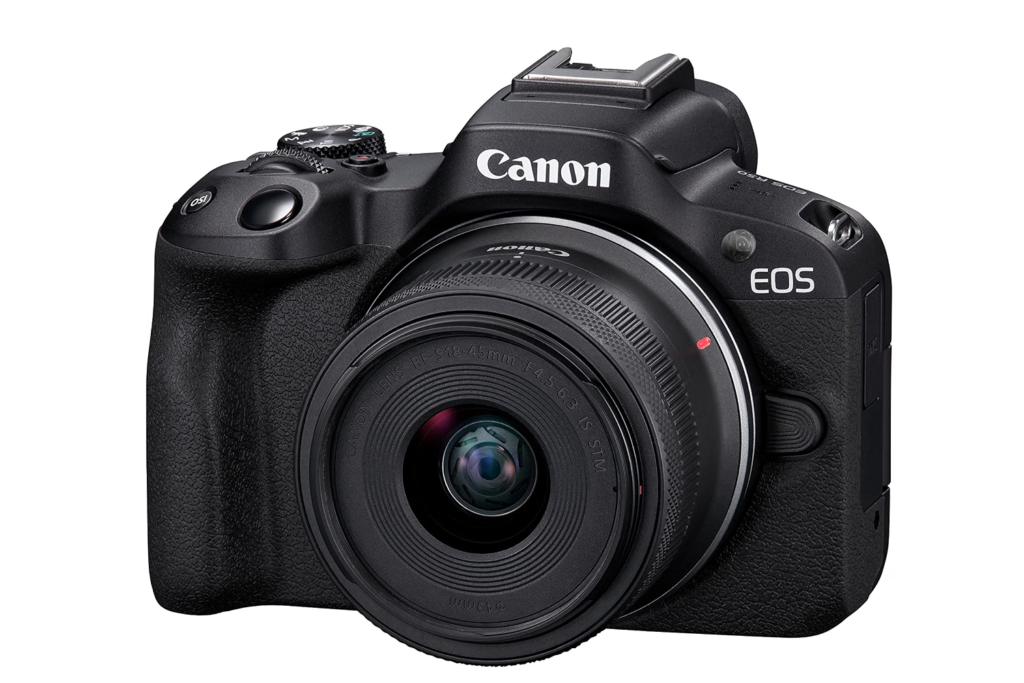
But is the Canon EOS R50 still worth buying, and what can you realistically expect from the 18-45mm kit lens?
Let’s take a closer look.
Canon EOS R50 + RF-S 18-45mm: Quick Overview
| Feature | Canon EOS R50 |
|---|---|
| Camera Type | APS-C Mirrorless |
| Sensor | 24.2MP APS-C CMOS |
| Processor | DIGIC X |
| Lens Mount | Canon RF |
| Included Lens | RF-S 18-45mm F4.5-6.3 IS STM |
| Effective Focal Length | Approx. 29-72mm on full-frame |
| Autofocus | Dual Pixel CMOS AF II |
| ISO Range | 100-32,000 |
| Continuous Shooting | Up to 12fps electronic first-curtain / up to 15fps electronic |
| Video | Up to 4K 30p |
| Slow Motion | Full HD 120p |
| Viewfinder | 2.36-million-dot OLED EVF |
| Display | 3-inch vari-angle touchscreen |
| Stabilization | Lens-based IS + Movie Digital IS |
| Connectivity | Wi-Fi, Bluetooth, USB-C |
| Battery | LP-E17 |
| Body Weight | Approx. 375g with battery and card |
| Best For | Beginners, travel, portraits and everyday photography |
What Is the Canon EOS R50?
The Canon EOS R50 is a compact APS-C mirrorless camera designed primarily for beginners and enthusiast creators.
It sits within Canon’s EOS R system, meaning users can choose from compatible RF and RF-S lenses as their photography skills develop.
The camera itself is small enough to carry comfortably while still providing many of the features you’d expect from a modern interchangeable-lens camera.
For a first mirrorless camera, that combination is appealing.
You get the simplicity of automatic shooting when you need it, but you can gradually learn manual photography as your confidence improves.
24.2MP APS-C CMOS Sensor
The EOS R50 features a 24.2MP APS-C CMOS sensor.
For everyday photography, this resolution is more than sufficient.
You can comfortably use the camera for:
- Portrait photography
- Family photography
- Travel
- Street photography
- Landscapes
- Food photography
- Product photography
- Social media
- YouTube thumbnails
The APS-C format also gives you more control over depth of field than a typical smartphone.
Pair the R50 with a fast prime lens later and you can create portraits with noticeably stronger background separation.
DIGIC X Image Processor
Canon’s DIGIC X processor powers the EOS R50.
The processor handles image processing, autofocus, burst shooting and video processing.
For a beginner camera, this provides a strong foundation.
The combination of the 24.2MP sensor and DIGIC X processor allows the R50 to produce detailed images while maintaining fast camera operation.
It also helps the camera handle Canon’s advanced autofocus features.
Canon EOS R50 Image Quality
Image quality is one of the biggest reasons to choose the EOS R50 over a smartphone.
In good lighting, the 24.2MP APS-C sensor produces detailed photographs with attractive colors and good dynamic range.
Canon cameras are also known for pleasing skin tones, which makes the R50 particularly suitable for family and portrait photography.
The camera can capture images in JPEG for immediate sharing or RAW format for more extensive editing.
RAW is especially useful if you’re learning photography because you can make significant adjustments to exposure, shadows, highlights and white balance during post-processing.
RF-S 18-45mm F4.5-6.3 IS STM Lens
The lens included with this particular package is the Canon RF-S 18-45mm F4.5-6.3 IS STM.
It’s a compact standard zoom designed specifically for APS-C EOS R cameras.
On the EOS R50, it provides an angle of view roughly equivalent to 29-72mm on a full-frame camera.
That makes it useful for everyday photography.
18mm
The wide end works well for:
- Travel
- Landscapes
- Groups
- Indoor scenes
- Everyday snapshots
- Casual vlogging
45mm
The telephoto end is better suited to:
- Portraits
- Details
- Food
- Product photos
- General photography
The lens isn’t designed to be a premium low-light optic. Its relatively narrow maximum aperture means it performs best when there is sufficient ambient light.
Its major advantage is its small size and portability.
Image Stabilization on the 18-45mm Lens
The RF-S 18-45mm lens includes optical image stabilization.
This can help reduce camera shake when shooting handheld, particularly at slower shutter speeds.
That can be useful when photographing:
- Indoor scenes
- Evening travel shots
- Static subjects
- Family moments
Image stabilization won’t freeze a moving subject, so it doesn’t replace a fast shutter speed when photographing people or sports.
But for stationary subjects, it can make handheld shooting more forgiving.
Canon EOS R50 Autofocus
Autofocus is one of the EOS R50’s strongest features.
The camera uses Canon’s Dual Pixel CMOS AF II system, with subject detection and tracking.
For beginners, good autofocus is important because it reduces the number of technically failed photographs.
The camera can recognize and track subjects such as people and animals, making it easier to keep moving subjects sharp.
This is especially useful for:
- Children
- Pets
- Family events
- Travel
- Casual sports
- Street photography
Eye Detection Autofocus
The R50 can detect and focus on eyes when photographing people.
For portraits, this is extremely useful.
Instead of manually selecting a focus point over the eye, you can allow the camera to identify the subject and maintain focus.
For family photography, this can save time and make spontaneous shooting easier.
It is one of the features that makes modern mirrorless cameras significantly more beginner-friendly than older DSLRs.
Canon EOS R50 for Portrait Photography
The R50 is a capable portrait camera, particularly when paired with a faster lens.
The bundled 18-45mm lens can certainly capture portraits, especially around the longer end of its zoom range.
However, if portraits become your primary interest, consider adding a fast RF or RF-S prime lens later.
A wider aperture can provide:
- Stronger background blur
- Better low-light performance
- More subject separation
- More creative control
This is one of the advantages of starting with an interchangeable-lens camera.
You aren’t limited to the kit lens.
Canon EOS R50 for Travel Photography
The EOS R50 and 18-45mm lens make a practical travel combination.
The setup is small enough to carry around without feeling like you’re carrying professional photography equipment.
The 18mm wide end is useful for landscapes and architecture, while the 45mm end provides a tighter perspective for portraits and details.
For travelers who want better image quality than a smartphone but don’t want a large camera bag, this combination makes a lot of sense.
Canon EOS R50 for YouTube and Vlogging
The EOS R50 can also be used for content creation.
It features a vari-angle touchscreen, allowing you to flip the display around and see yourself while recording.
That’s particularly useful for:
- YouTube
- Vlogging
- Tutorials
- Product reviews
- Travel videos
- Instagram content
The 18mm end of the kit lens provides a reasonably wide perspective, although serious vloggers may eventually prefer a wider lens.
The camera’s autofocus can also track faces and eyes, helping keep the presenter in focus while recording.
4K Video Recording
The EOS R50 supports 4K video recording, making it useful for modern content creation.
You can use it for:
- YouTube videos
- Travel vlogs
- Product demonstrations
- Tutorials
- Family videos
- Social media clips
The camera can record 4K at up to 30 frames per second.
It also offers Full HD high-frame-rate recording for slow-motion effects.
For casual creators, this is more than enough to get started.
Full HD 120fps Slow Motion
The R50 supports Full HD recording at up to 120fps.
This allows you to slow footage down during editing.
Slow motion can be particularly effective for:
- Travel B-roll
- Sports
- Food videos
- Fashion
- Outdoor activities
- Product demonstrations
It’s a useful creative option, even if you don’t use it in every video.
Vari-Angle Touchscreen
The 3-inch vari-angle touchscreen is another important feature for beginners and creators.
You can flip the display outward and rotate it toward yourself.
This makes it much easier to:
- Record yourself
- Shoot at unusual angles
- Compose low-angle photographs
- Photograph yourself
- Create vertical content
The touchscreen also makes navigating menus and selecting focus points more intuitive.
For people coming from smartphones, this is an especially welcome feature.
Electronic Viewfinder
Unlike some creator cameras, the EOS R50 includes a built-in electronic viewfinder.
The approximately 2.36-million-dot OLED EVF provides a traditional way to compose photographs.
This is useful when shooting outdoors in bright sunlight.
It also gives photographers a more immersive shooting experience compared with using only the rear LCD.
For photography beginners, having both an EVF and articulating touchscreen is a significant advantage.
Canon EOS R50 Battery Life
The camera uses a Canon LP-E17 battery.
Battery life depends on factors such as:
- EVF usage
- LCD usage
- Video recording
- Autofocus
- Wi-Fi
- Image review
For a full day of travel photography or extended video recording, carrying a spare battery is recommended.
If you’re mainly photographing casually, one battery may be sufficient for a moderate shooting session.
Compact and Lightweight Design
The EOS R50 is one of the more portable cameras in Canon’s EOS R lineup.
The body weighs approximately 375 grams including the battery and memory card.
Add the compact 18-45mm lens and the entire kit remains relatively easy to carry.
This makes it suitable for:
- Students
- Travelers
- Beginners
- Families
- Everyday photographers
- Casual creators
The portability also makes it more likely that you’ll take the camera with you instead of leaving it at home.
Canon EOS R50 Pros and Cons
Pros
- 24.2MP APS-C sensor
- Excellent image quality
- DIGIC X processor
- Strong Dual Pixel CMOS AF II autofocus
- Eye and subject detection
- Compact and lightweight
- RF/RF-S interchangeable lenses
- Vari-angle touchscreen
- Built-in electronic viewfinder
- 4K video recording
- Full HD 120fps slow motion
- RF-S 18-45mm lens is compact
- Optical stabilization in the kit lens
- Excellent beginner camera
- Good for travel photography
- Useful for YouTube and vlogging
Cons
- 18-45mm kit lens has a relatively slow aperture
- No in-body image stabilization
- Battery life is modest for heavy video use
- Limited native lens selection compared with older DSLR systems
- 4K video has some limitations
- Not designed for professional sports or wildlife photography
- Kit lens isn’t ideal for serious low-light shooting
Canon EOS R50 vs Smartphone
The biggest question for many first-time buyers is whether they actually need a camera.
Modern smartphones are excellent at computational photography.
They are convenient, compact and always available.
So why buy an EOS R50?
The main reason is control.
The R50 gives you:
- APS-C sensor
- Interchangeable lenses
- Optical zoom options
- RAW files
- Manual exposure
- Better depth-of-field control
- Electronic viewfinder
- External accessories
- Greater creative flexibility
A smartphone is ideal for quick snapshots.
The R50 is better if you want to learn photography and build a proper camera system.
Canon EOS R50 vs Canon EOS R100
Both cameras are designed for beginners, but the EOS R50 is positioned as the more capable and modern option.
| Feature | EOS R50 | EOS R100 |
|---|---|---|
| Sensor | 24.2MP APS-C | 24.1MP APS-C |
| Processor | DIGIC X | DIGIC 8 |
| Autofocus | Dual Pixel CMOS AF II | Dual Pixel CMOS AF |
| Screen | Vari-angle touchscreen | Fixed LCD |
| EVF | Yes | Yes |
| 4K Video | Yes | Yes |
| Beginner Friendly | Excellent | Excellent |
| Creator Features | More extensive | More basic |
If the price difference is reasonable, the EOS R50 is generally the more attractive choice for users interested in both photography and video.
Who Should Buy the Canon EOS R50?
The EOS R50 with the RF-S 18-45mm lens is best suited to:
- Beginner photographers
- Smartphone users upgrading to a camera
- Students
- Travel photographers
- Family photographers
- Hobbyists
- Beginner YouTubers
- Social media creators
- People learning photography
It is less suitable for:
- Professional sports photographers
- Serious wildlife photographers
- Full-time filmmakers
- Users who need a large professional lens lineup immediately
- Photographers who require in-body stabilization
Is Canon EOS R50 with 18-45mm Lens Worth Buying?
For beginners, yes.
The camera provides an excellent combination of image quality, autofocus, portability and ease of use.
The 18-45mm lens isn’t spectacular from a low-light or background-blur perspective, but that’s not its purpose.
Its job is to be a small, lightweight, everyday lens that lets beginners learn the camera without making the kit unnecessarily large.
As your skills develop, you can add a faster prime lens or a telephoto lens.
That makes the R50 a camera system rather than simply a one-time purchase.
Conclusion
The Canon EOS R50 with RF-S 18-45mm f/4.5-6.3 IS STM lens is an excellent entry-level mirrorless combination for people who want to take photography more seriously.
The 24.2MP APS-C sensor delivers strong image quality, while Canon’s Dual Pixel CMOS AF II system makes focusing on people and moving subjects much easier.
The compact 18-45mm lens complements the small camera body particularly well. It isn’t the brightest lens, but it provides a useful everyday focal range without adding unnecessary weight.
The R50 is also capable of handling 4K video, making it useful for beginners who want to experiment with YouTube, vlogging and social media.
Its lack of in-body stabilization and the kit lens’s modest aperture are limitations, but neither is a deal-breaker for its target audience.
For beginners, travelers, families and hybrid photo/video creators, the Canon EOS R50 remains one of the more appealing entry-level mirrorless cameras.
Our Rating: 4.5/5
Best for: Beginner photography, travel, family photos, portraits, YouTube and everyday content creation.
Frequently Asked Questions
Is the Canon EOS R50 a 24.2MP camera?
Yes. The EOS R50 features an approximately 24.2MP APS-C CMOS sensor.
What lens comes with the Canon EOS R50?
This kit includes the RF-S 18-45mm F4.5-6.3 IS STM compact standard zoom lens.
Is the Canon EOS R50 good for beginners?
Yes. Its automatic modes, excellent autofocus, touchscreen controls, electronic viewfinder and interchangeable lenses make it particularly suitable for beginners.
Is Canon EOS R50 good for photography?
Yes. The 24.2MP APS-C sensor delivers good image quality for portraits, travel, family, street and everyday photography.
Is Canon EOS R50 good for YouTube?
Yes. The vari-angle screen, autofocus and 4K video recording make it suitable for beginner YouTubers and content creators.
Does the Canon EOS R50 have image stabilization?
The camera body does not feature sensor-shift IBIS. The included RF-S 18-45mm lens provides optical image stabilization, and Canon also provides digital stabilization options for movie recording.
Is the RF-S 18-45mm lens good?
It is a good compact starter lens. Its biggest advantages are portability, useful everyday focal lengths and optical stabilization. Its relatively slow aperture means it isn’t the best option for low-light photography or strong background blur.
Can I change lenses on the Canon EOS R50?
Yes. The EOS R50 uses Canon’s RF mount and supports compatible RF and RF-S lenses.
Canon EOS R50 RF-S18-45mm f/4.5-6.3 is STM Mirrorless Camera 12% OFF