
Choosing the right thermostat can make a noticeable difference in your home’s comfort, energy efficiency, and monthly electricity bills. While traditional thermostats have been reliable for decades, smart thermostats offer advanced features such as remote control, automated scheduling, and energy monitoring.
So, which one is the better choice?
In this guide, we’ll compare smart thermostats vs traditional thermostats across key factors including price, functionality, installation, energy savings, convenience, and long-term value to help you decide which option best fits your home.
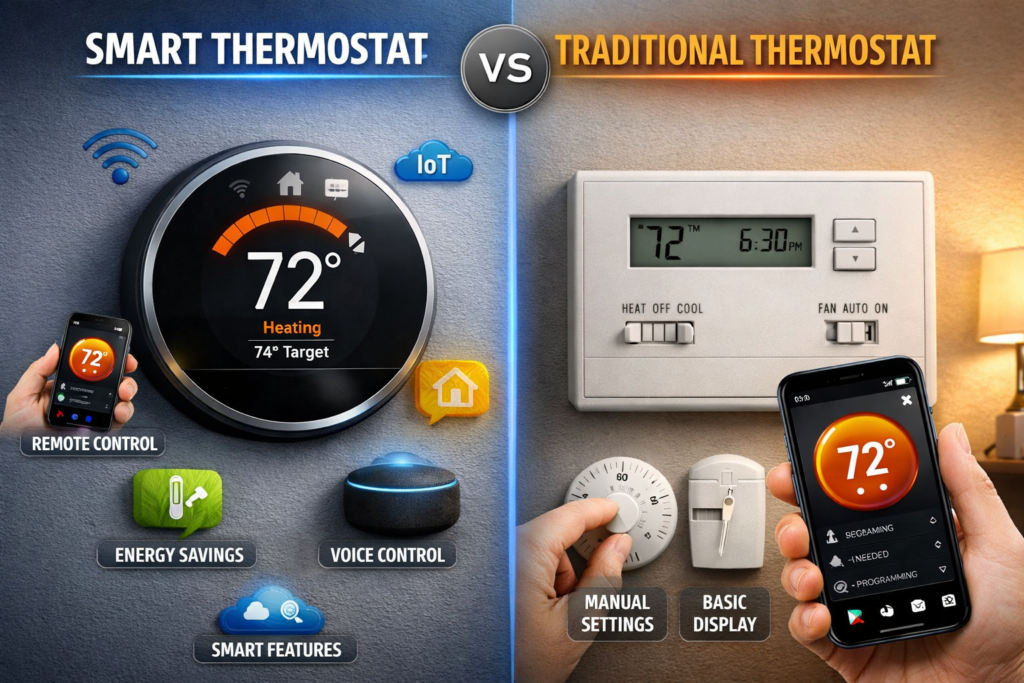
What Is a Traditional Thermostat?
A traditional thermostat is a basic temperature control device that manually regulates your home’s heating and cooling system.
There are two common types:
- Manual thermostats – You adjust the temperature yourself whenever needed.
- Programmable thermostats – Allow you to create basic schedules for different times of the day.
While dependable and affordable, traditional thermostats generally lack internet connectivity, remote access, and intelligent automation.
What Is a Smart Thermostat?
A smart thermostat is a Wi-Fi-enabled thermostat that connects to your home’s network and can be managed using a smartphone, tablet, or voice assistant.
Modern smart thermostats include features such as:
- Mobile app control
- Learning algorithms
- Automatic scheduling
- Energy usage reports
- Geofencing
- Vacation mode
- Voice assistant compatibility
- Smart home integration
These capabilities help improve convenience while reducing unnecessary energy consumption.
Smart Thermostat vs Traditional Thermostat: Quick Comparison
| Feature | Smart Thermostat | Traditional Thermostat |
|---|---|---|
| Remote Control | ✅ Yes | ❌ No |
| Wi-Fi Connectivity | ✅ Yes | ❌ No |
| Smartphone App | ✅ Yes | ❌ No |
| Automatic Learning | ✅ Available | ❌ No |
| Voice Assistant Support | ✅ Yes | ❌ No |
| Energy Reports | ✅ Yes | ❌ No |
| Geofencing | ✅ Available | ❌ No |
| Manual Temperature Control | ✅ Yes | ✅ Yes |
| Basic Scheduling | ✅ Yes | ✅ On programmable models |
| Installation Cost | Moderate | Lower |
| Energy Efficiency | High | Moderate |
| Long-Term Savings | Higher | Limited |
1. Ease of Use
Traditional Thermostat
Traditional thermostats are simple and straightforward. You manually set the desired temperature, and the HVAC system maintains it until you make another adjustment.
Pros:
- Easy to understand
- Minimal setup
- Reliable operation
Cons:
- Requires frequent manual changes
- Easy to forget temperature adjustments
Smart Thermostat
Smart thermostats require a brief setup process but are easy to manage afterward through intuitive mobile apps.
Benefits include:
- Automated schedules
- Remote adjustments
- User-friendly interfaces
- Personalized settings
Winner: Smart Thermostat
2. Energy Efficiency
Energy efficiency is one of the biggest differences between the two.
Traditional Thermostat
A manual thermostat maintains the selected temperature continuously, even when no one is home, unless you remember to change it.
Smart Thermostat
Smart thermostats automatically reduce heating or cooling when the house is empty, adjust temperatures based on occupancy, and optimize HVAC operation.
Features like learning schedules and Eco Mode help reduce energy waste.
Winner: Smart Thermostat
3. Electricity Bill Savings
Lower utility costs are a major reason homeowners upgrade to smart thermostats.
Traditional Thermostat
Energy savings depend entirely on manual adjustments or basic programmed schedules.
Smart Thermostat
By combining scheduling, occupancy detection, weather awareness, and energy optimization, smart thermostats can help reduce unnecessary HVAC runtime.
Over time, many homeowners notice meaningful reductions in heating and cooling expenses.
Winner: Smart Thermostat
4. Installation
Traditional Thermostat
Installation is usually straightforward because of the simple wiring and limited features.
Smart Thermostat
Many smart thermostats are also designed for DIY installation, though some models may require a common (C) wire or adapter.
Professional installation may be recommended for older HVAC systems or complex multi-zone setups.
Winner: Traditional Thermostat (for simplicity)
5. Remote Access
This is where smart thermostats clearly stand out.
Traditional Thermostat
You must be physically present to change the temperature.
Smart Thermostat
Using a mobile app, you can:
- Adjust temperature remotely
- Turn the HVAC system on or off
- Receive maintenance alerts
- Change schedules
- Monitor system status
Winner: Smart Thermostat
6. Smart Home Compatibility
Traditional thermostats operate independently.
Smart thermostats integrate with popular smart home ecosystems, allowing voice commands and automation routines.
Examples include:
- Voice-controlled temperature adjustments
- Automated routines based on occupancy
- Integration with lighting and security systems
Winner: Smart Thermostat
7. Maintenance Features
Traditional Thermostat
Provides no system diagnostics or reminders.
Smart Thermostat
Many models can notify you when:
- HVAC filters need replacement
- Maintenance is due
- Temperature readings are unusual
- System performance declines
These reminders can help maintain HVAC efficiency.
Winner: Smart Thermostat
8. Initial Cost
Traditional thermostats generally cost less upfront.
Smart thermostats have a higher purchase price because of their advanced hardware and software capabilities.
However, the long-term energy savings may offset the higher initial investment for many homeowners.
Winner: Traditional Thermostat (upfront affordability)
9. Long-Term Value
While traditional thermostats perform their basic function reliably, smart thermostats provide additional value through automation, convenience, and improved energy management.
Benefits include:
- Reduced electricity bills
- Greater comfort
- Better HVAC efficiency
- Smart home integration
- Remote monitoring
Winner: Smart Thermostat
Pros and Cons
Smart Thermostat
Pros
- Energy-efficient operation
- Remote smartphone control
- Automatic scheduling
- Learning technology
- Voice assistant compatibility
- Energy reports
- Smart home integration
- Vacation mode
- Geofencing
Cons
- Higher purchase price
- Requires Wi-Fi for advanced features
- Some models require a C-wire
- More features may involve a learning curve
Traditional Thermostat
Pros
- Affordable
- Easy to install
- Simple operation
- Reliable performance
- Minimal maintenance
Cons
- No remote access
- Limited scheduling
- No energy reports
- No automation
- Higher potential for energy waste
Which Thermostat Is Best for Different Homeowners?
Choose a Smart Thermostat if you:
- Want to reduce electricity bills
- Travel frequently
- Own a smart home
- Prefer automation
- Want remote control
- Value long-term energy savings
Choose a Traditional Thermostat if you:
- Have a limited budget
- Prefer simple controls
- Rarely adjust temperatures
- Don’t need internet-connected features
- Have an older HVAC system without smart compatibility
Is Upgrading Worth It?
For many homeowners, upgrading to a smart thermostat is a worthwhile investment. Although the upfront cost is higher than a traditional thermostat, features like intelligent scheduling, remote management, and energy monitoring can improve comfort and help reduce ongoing heating and cooling expenses.
If you already own a programmable thermostat and are satisfied with its performance, the upgrade may be less urgent. However, for households looking to improve convenience and energy efficiency, a smart thermostat offers significant long-term advantages.
Final Thought
Both traditional and smart thermostats effectively regulate indoor temperatures, but they serve different needs.
A traditional thermostat is ideal for homeowners seeking a simple, low-cost solution with minimal setup.
A smart thermostat, on the other hand, delivers a more advanced experience through intelligent automation, energy-saving features, remote access, and smart home integration. While it requires a higher initial investment, its convenience and potential long-term savings make it the better choice for most modern households.
Frequently Asked Questions (FAQs)
Do smart thermostats really save more energy than traditional thermostats?
Yes. Smart thermostats use automation, occupancy detection, and optimized scheduling to reduce unnecessary heating and cooling.
Can I replace my traditional thermostat with a smart thermostat?
In many cases, yes. Be sure to verify compatibility with your HVAC system before purchasing.
Do smart thermostats work without Wi-Fi?
Basic temperature control typically works without Wi-Fi, but advanced features such as app control and remote access require an internet connection.
Are smart thermostats difficult to use?
Most modern smart thermostats feature intuitive interfaces and companion apps, making them easy for beginners after initial setup.
Which thermostat lasts longer?
Both traditional and smart thermostats can provide many years of reliable service when properly installed and maintained.