
Buying a vacuum cleaner seems straightforward—until you realize how many models, features, and price points are available. Many buyers assume that choosing the most expensive vacuum automatically guarantees the best cleaning performance. Others simply purchase the first discounted model they find online. Unfortunately, these decisions often lead to disappointment, unnecessary expenses, or a vacuum that doesn’t meet their household’s needs.
The truth is that the best vacuum cleaner isn’t the one with the highest price tag—it’s the one that matches your home, flooring, lifestyle, and cleaning habits. Whether you’re buying your first vacuum cleaner or upgrading an old one, avoiding a few common mistakes can save you money and ensure years of reliable performance.
In this post, we’ll walk through the biggest mistakes people make when purchasing a vacuum cleaner and explain how to choose the right one confidently.
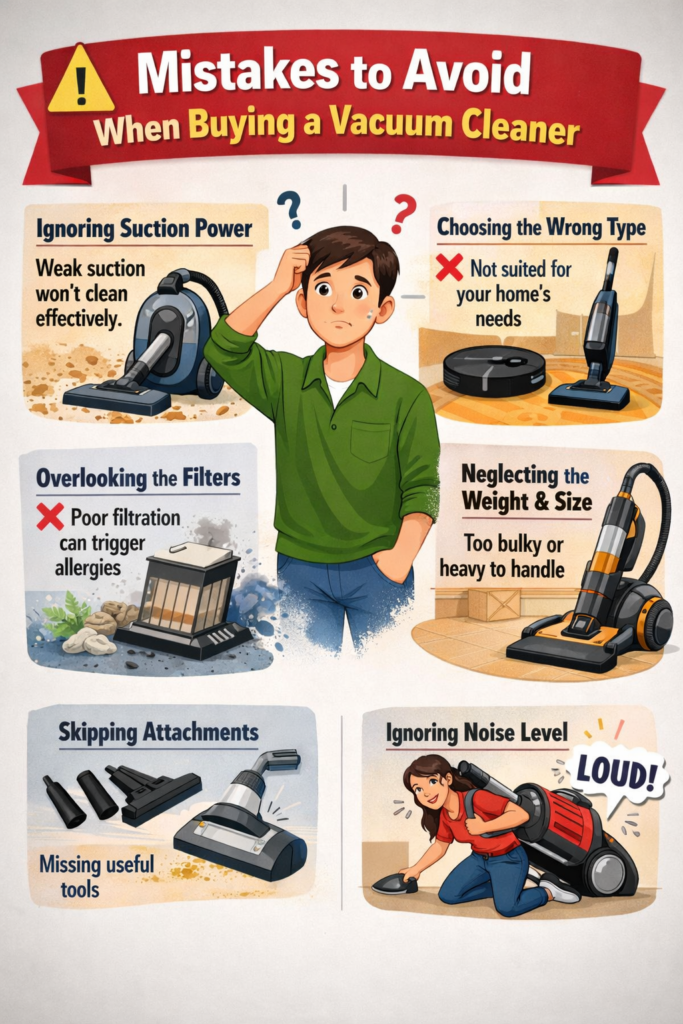
1. Buying Based Only on Price
One of the biggest mistakes is choosing the cheapest vacuum available or assuming the most expensive model is automatically the best.
A budget vacuum may lack suction power, durability, and filtration, while a premium model may include features you’ll never use.
What to Do Instead
Evaluate:
- Your home size
- Floor types
- Frequency of cleaning
- Family size
- Pet ownership
Choose the model that provides the best value—not simply the lowest or highest price.
2. Ignoring Your Floor Type
Different vacuum cleaners perform differently on various surfaces.
For example:
- Hardwood floors require soft brush rolls.
- Thick carpets need stronger suction.
- Tiles benefit from adjustable suction.
- Mixed flooring works best with multi-surface vacuums.
Buying a vacuum designed mainly for carpets when your home has tile flooring can reduce cleaning efficiency.
3. Overlooking Suction Power
Many shoppers focus only on wattage.
However, motor wattage doesn’t always translate into better cleaning.
More important factors include:
- Airflow
- Air watts
- Sealed suction
- Brush roll efficiency
A well-designed 700W vacuum may outperform a poorly designed 1400W model.
4. Choosing the Wrong Vacuum Type
Every home has different cleaning requirements.
Common options include:
| Vacuum Type | Best For |
|---|---|
| Upright | Large carpeted homes |
| Canister | Mixed flooring |
| Stick | Small apartments |
| Handheld | Cars and furniture |
| Robot | Daily maintenance |
| Wet & Dry | Heavy-duty cleaning |
Selecting the wrong category often leads to frustration.
5. Forgetting About Pet Hair
If you own pets, standard vacuum cleaners may struggle with fur.
Look for features like:
- Motorized pet brush
- Anti-tangle roller
- HEPA filtration
- Strong suction
- Hair collection tools
Pet-specific vacuums save significant cleaning time.
6. Ignoring HEPA Filtration
Many inexpensive vacuums simply recirculate dust into the room.
If anyone in your household has:
- Allergies
- Asthma
- Dust sensitivity
Choose a vacuum with a true HEPA filter.
HEPA filters trap up to 99.97% of microscopic particles, improving indoor air quality.
7. Not Checking Dustbin Capacity
A tiny dustbin means frequent emptying.
Choose according to home size.
| Home Size | Recommended Dust Capacity |
|---|---|
| Small apartment | 0.5–1 L |
| Medium home | 1–2 L |
| Large home | 2 L or more |
8. Ignoring Noise Levels
Some vacuum cleaners are surprisingly loud.
If you:
- Work from home
- Have young children
- Own nervous pets
Look for models below 70–75 dB for quieter operation.
9. Buying Without Checking Accessories
Attachments greatly improve versatility.
Useful accessories include:
- Crevice tool
- Dusting brush
- Upholstery nozzle
- Mattress attachment
- Pet hair tool
- Extension wand
A vacuum with multiple attachments can replace several separate cleaning tools.
10. Choosing Cordless Without Considering Battery Life
Cordless vacuums offer convenience, but battery runtime varies.
Typical runtimes:
- Budget models: 20–30 minutes
- Mid-range: 35–50 minutes
- Premium: 60–90 minutes
Choose a battery that matches your home’s cleaning needs.
11. Forgetting About Maintenance Costs
The purchase price isn’t the only expense.
Consider:
- Replacement filters
- Dust bags
- Brush rolls
- Battery replacement
- Spare parts availability
A low-cost vacuum may become expensive over time if maintenance costs are high.
12. Ignoring Warranty and Service Availability
A good warranty reflects the manufacturer’s confidence in its product.
Before purchasing, check:
- Warranty duration
- Service centers near you
- Availability of spare parts
- Customer support reputation
This becomes especially important after the warranty period.
13. Falling for Marketing Buzzwords
Terms like:
- Cyclonic Technology
- Turbo Power
- Ultra Suction
- Smart Cleaning
sound impressive but don’t always indicate better performance.
Instead, compare measurable specifications such as suction performance, filtration quality, and customer reviews.
14. Not Reading Verified Customer Reviews
Manufacturer descriptions highlight strengths but rarely mention limitations.
Verified buyer reviews often reveal:
- Long-term reliability
- Build quality
- Battery performance
- Noise levels
- Customer service experience
Reading a variety of reviews helps set realistic expectations.
15. Buying Without Comparing Multiple Brands
Many buyers purchase the first recognizable brand they encounter.
Instead, compare factors like:
| Feature | Brand A | Brand B | Brand C |
|---|---|---|---|
| Suction Power | ★★★★★ | ★★★★☆ | ★★★★☆ |
| Filtration | HEPA | HEPA | Standard |
| Warranty | 2 Years | 2 Years | 1 Year |
| Price | Premium | Mid-range | Budget |
| Best For | Large Homes | Families | Small Homes |
A comparison helps you find the best balance of features, performance, and price.
Quick Checklist Before Buying
Before placing your order, ask yourself:
- ✔ What type of flooring do I have?
- ✔ Do I have pets?
- ✔ Does anyone have allergies?
- ✔ How large is my home?
- ✔ Do I prefer corded or cordless?
- ✔ Is the dustbin large enough?
- ✔ Is battery life sufficient?
- ✔ Are replacement parts easily available?
- ✔ Is the warranty adequate?
- ✔ Have I compared multiple brands?
If you can answer “yes” to these questions, you’re far more likely to choose a vacuum cleaner that suits your needs.
Frequently Asked Questions
What is the biggest mistake people make when buying a vacuum cleaner?
The most common mistake is purchasing based solely on price instead of considering suction performance, floor type, filtration, and overall cleaning needs.
Should I buy a bagged or bagless vacuum?
Bagless models are more economical over time, while bagged vacuums are often a better choice for allergy sufferers because they contain dust more effectively during disposal.
Is a higher wattage vacuum always better?
No. Higher wattage indicates energy consumption, not necessarily better cleaning. Suction design, airflow, and brush efficiency are more important.
Do I need a HEPA filter?
If you have allergies, asthma, pets, or want cleaner indoor air, a HEPA filter is highly recommended.
Is a cordless vacuum suitable for an entire house?
It depends on battery life and your home’s size. Larger homes may require a model with a longer runtime or a spare battery.
Final Thoughts
Choosing the right vacuum cleaner doesn’t have to be overwhelming. By avoiding common mistakes—such as focusing only on price, overlooking floor compatibility, ignoring filtration, or skipping product comparisons—you can invest in a vacuum that delivers reliable performance and long-term value.
Take time to compare features, read verified reviews, and think about your household’s unique cleaning needs. A well-chosen vacuum cleaner not only keeps your home cleaner but also makes everyday maintenance easier, saving you time and money in the long run.